
The login-email-verification screen prompts the user to enter a verification code sent to their email address to confirm their identity during the login flow.
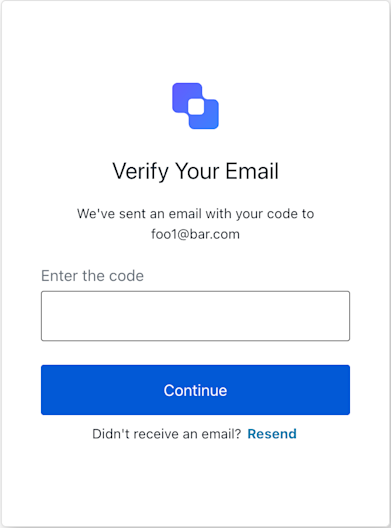
Login Email Verification

Import

Each screen has its own set of hooks and methods. The SDK supports partial import and root import for each screen.
  • Using partial import allows you to include only the code you need for your specific use case.
  • Using root import allows you to load all screens from a single bundle useful when you want a unified build to handle all possible screens.
Import Example
// root import
import { useLoginEmailVerification } from '@auth0/auth0-acul-react';

// partial import
import {
  useLoginEmailVerification,
  // Context hooks
  useUser,
  useTenant,
  useBranding,
  useClient,
  useOrganization,
  usePrompt,
  useScreen,
  useTransaction,
  useUntrustedData,
  // Common hooks
  useCurrentScreen,
  useAuth0Themes,
  useErrors,
  // Utility hooks
  useChangeLanguage,
  useResend,
  // Methods
  continueWithCode,
  resendCode,
} from '@auth0/auth0-acul-react/login-email-verification';

function LoginEmailVerificationForm() {
  const { continueWithCode } = useLoginEmailVerification();
  return (
    <button onClick={() => continueWithCode({ code: '123456' })}>
      Verify
    </button>
  );
}

Context Hooks

Screen-scoped hooks that provide read-only access to Auth0 context data on the login-email-verification screen. Import them from @auth0/auth0-acul-react/login-email-verification.
useBranding
This hook provides branding configurations, such as logo, colors, and theme settings displayed on the login-email-verification screen.
Example
import { useBranding } from '@auth0/auth0-acul-react/login-email-verification';
function CustomTheme() {
  const branding = useBranding();
}
useClient
This hook provides client-related configurations, such as id, name, and logoUrl, for the login-email-verification screen.
Example
import { useClient } from '@auth0/auth0-acul-react/login-email-verification';
function AppInfo() {
  const client = useClient();
}
useOrganization
This hook provides information about the user’s Organization if the login is Organization scoped. Returns null when no Organization context is present.
Example
import { useOrganization } from '@auth0/auth0-acul-react/login-email-verification';
function OrgSelector() {
  const organization = useOrganization();
  if (!organization) {
    return <p>No organization context</p>;
  }
}
usePrompt
This hook contains data about the current prompt in the authentication flow.
Example
import { usePrompt } from '@auth0/auth0-acul-react/login-email-verification';
function FlowInfo() {
  const prompt = usePrompt();
}
useScreen
This hook contains details specific to the login-email-verification screen, including its configuration and context.
Example
import { useScreen } from '@auth0/auth0-acul-react/login-email-verification';
function ScreenDebug() {
  const screen = useScreen();
}
useTenant
This hook contains data related to the tenant, such as id and associated metadata.
Example
import { useTenant } from '@auth0/auth0-acul-react/login-email-verification';
function TenantInfo() {
  const tenant = useTenant();
}
useTransaction
This hook provides transaction-specific data for the login-email-verification screen, such as active connections and current flow state.
Example
import { useTransaction } from '@auth0/auth0-acul-react/login-email-verification';
function TransactionInfo() {
  const transaction = useTransaction();
}
useUntrustedData
This hook handles untrusted data passed to the screen, such as parameters from URL query strings.
Example
import { useUntrustedData } from '@auth0/auth0-acul-react/login-email-verification';
function PrefilledForm() {
  const untrustedData = useUntrustedData();
}
useUser
This hook provides details of the active user, including username, email, and available authentication methods.
Example
import { useUser } from '@auth0/auth0-acul-react/login-email-verification';
function UserProfile() {
  const user = useUser();
}
useLoginEmailVerification
This hook returns all methods and context available on the login-email-verification screen.

Methods

continueWithCode
void | Promise<void>
This method submits the verification code entered by the user to proceed with email verification.
Example
import { useLoginEmailVerification } from '@auth0/auth0-acul-react/login-email-verification';

function VerifyEmail() {
  const { continueWithCode } = useLoginEmailVerification();
  return (
    <button onClick={() => continueWithCode({ code: '123456' })}>
      Verify
    </button>
  );
}
resendCode
void | Promise<void>
This method requests a new verification code to be sent to the user’s email address.
Example
import { useLoginEmailVerification } from '@auth0/auth0-acul-react/login-email-verification';

function ResendCode() {
  const { resendCode } = useLoginEmailVerification();
  return (
    <button onClick={() => resendCode()}>
      Resend Code
    </button>
  );
}

Common/Utility Hooks

This hook gets the current theme options with flattened configuration from branding context.
This hook returns a function for changing the display language on the current ACUL screen.
This hook gets the current screen context and state.
This hook reads and manages server, client, and developer errors on the screen.
This hook manages resend cooldown state and availability for code resend actions.